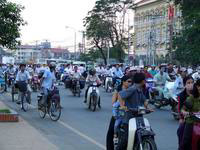
Ho Chi Minh City © Tracy MolonyHo Chi Minh City, better known by its former name of Saigon, is a brazen, industrious and dense metropolis, the largest city in Vietnam and the business capital of the country. With a population of five million, it is crowded, noisy and dirty, yet it is also exciting and historic, the essence of the nation.
Located on the Saigon River on the edge of the Mekong Delta, Saigon became the capital of the Republic of South Vietnam and was the American headquarters during the Vietnam War. Two years later the Communist north took control of the country, the city’s name was changed to Ho Chi Minh City, and recession and poverty ensued.
Today Ho Chi Minh City has a cosmopolitan and energetic atmosphere, and having actively welcomed the new capitalist principle, the business-minded spirit of the people is much in evidence. Although relatively modern, it has still managed to hold onto its Asian character, and fine restaurants, smart hotels and chic bars line the sidewalks crammed with noodle stands, markets and shoeshine boys. The buzzing of motorbikes and scooters merges with the cries of street vendors and the urgent business of stall owners, selling barbecued dog, writhing snakes and tropical fruits. The sight of a family of four balanced precariously on a scooter, a squealing pig strapped onto the back of a bicycle, bowed heads topped by pointed lampshade-style hats and orange-clothed monks are just some of the vibrant images the city has to offer.
Although overshadowed by modern and Asiatic influences, a little of Ho Chi Minh City’s French colonial charm still remains, evident in the graceful architecture, wide boulevards, and a sidewalk cafe society. It is not for the attractions that one visits Ho Chi Minh City however, but for the vibrancy of its street life, and its proximity to the Mekong Delta.
Wednesday, January 17, 2007
Ho Chi Minh City Travel Guide
Hanoi Travel Guide
Hanoi was founded in 1010, and became the centre of government for the Indochina Union under French rule in 1888. In 1954 it became the official capital of independent Vietnam. Today ancient crumbling buildings dating from the 11th century lie scattered among grand French colonial residences, while shrines and monuments to Vietnam's first president, Ho Chi Minh, sit in the shadow of modern high-rise buildings. The streets of the Old Quarter preserve age-old customs, where trade takes one back half a century, and temples, pagodas and monuments reflect the historic character of Vietnam.
Although a city of historical importance, and the social and cultural centre of Vietnam, it is a surprisingly modest and charming place, far slower and less developed than Ho Chi Minh City in the south. Hanoi has retained its appealing sense of the old world, despite the onset of a brisk tourism trade in 1993, absorbing the boom of hotels, travellers' hangouts and Internet cafes, and the gradual infiltration of western-style food and fashions into the once inaccessible city.
As the early morning mist rises from the serene Hoan Kiem Lake, tracksuit-clad elders perform the slow movements of tai chi, like park statues coming to life. Streets become filled with activity, mopeds and bicycles weave among pedestrians, while cyclo drivers (three-wheeled bicycle taxis) clamour for attention, and postcard vendors cluster around tourists like bees sensing an open honey pot.
Hanoi is fast becoming one of the most enticing and interesting cities in Asia. As a cultural centre there are traditional water puppet shows, and music and dance performances. It is also a good base for excursions to the beautiful Halong Bay, or into the Hoang Lien Mountains inhabited by several hill tribes
Tuesday, December 26, 2006
Christmas Traditions Come at a Price
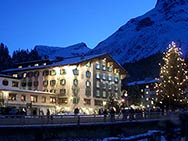
Dec. 22, 2006 — On Christmas morning 14 years ago, a frozen fog penetrated by the first rays of sun shrouded the countryside around Bath, England, in a silvery shimmer. It seemed a perfect holiday atmosphere for those of us on the front steps of Lucknam Park, an 18th century country mansion converted into a hotel.
We — British and American guests — were waiting for the arrival of Father Christmas — better known here as Santa Claus. By tradition, he did not arrive down one of the hotel's chimneys during the night, but by Victorian-era carriage on Christmas morning.
The clip-clop of hooves from the carriage hidden by the fog heightened the excitement of children bouncing from one part of the hotel to another and promised relief for parents. The Americans, of course, had never considered that Santa would come when they could see him.
Out of the tinsel-like fog, Father Christmas arrived, bearing gifts for all. Though there was mulled wine and a huge Christmas lunch and another day to go, this was the highlight of the three-day "Christmas Break."
Christmas breaks were a tradition in Britain long before I discovered them.
Families went away for three days to celebrate: Christmas Eve, Christmas Day and "Boxing Day," Dec. 26. Boxing day is a term that dates to Victorian times when the aristocracy would box up leftovers the day after Christmas and deliver them to servants who, of course, were "in service" on Christmas.
But since my time at Lucknam Park, when the dollar was strong and hotel prices low enough for middle class families to afford them, Christmas breaks have been embraced by luxury hotels targeting the super rich and the merely rich.
The popularity has spread from Britain to the rest of Europe and beyond, to the United States and far flung places like Bora Bora and New Zealand.
Why the popularity? Rachael Hill of Lucknam Park says Americans who visited last Christmas for the third time used two words: "Truly traditional."
There may be other reasons. Family heads busy making money don't often have time for their families. This is one brief solution and doesn't face the two-week booking policy of most luxury Caribbean and Rocky Mountain resorts. And many families these days don't have a family tradition of Christmas, so why not connect with traditional trappings in a hotel?
Thursday, December 21, 2006
Hong Kong, a.k.a. treasure island
By Rosemary McClure, Times Staff WriterDecember 17, 2006
Wednesday, December 20, 2006
Flight plan for best seats
Even if you can’t manage the dosh, the frequent flyer points or the charm to score a seat amid the ever-increasing levels of luxury in business class, there are ways and means to increase your comfort levels in ‘cattle class’ economy.
Firstly, selecting the best seat and row is paramount in getting the most leg and elbow room as well as peace and quiet.
The Australian’s Steve Creedy has plenty of tips on how to choose the best and avoid the worst seats on your next long-haul flight.
And as more airlines allow travellers to check ourselves in either ahead of time online or at self-service kiosks at the airport, we have more opportunity to maximise our comfort levels, which is where the Seat Guru website comes in very handy.
This nifty site, created five years ago by frequent flyer Matthew Daimler, has seating configuration maps of most of the commercial aircraft in operation. You can see which seats are the best and worst onboard – and why they are rated that way.
Contrary to Steve Creedy’s argument that the seats up the back of the plane are the worst, Seat Guru give rows 70 to 73 of a Qantas Boeing 747-400 the thumbs up. Seats A and B, as well as J and K, are the only two-somes in economy with the window seats scoring extra elbow room.
But elbow room isn’t all you want in a seat position. Being up the back means a long wait to disembark (first on and last off). Plus the rear of the plane usually experiences the worst of the turbulence in rough weather. And sometimes, the rows at the rear of a plane are a few centimetres closer together.
The trick is to make you own list of what’s important: leg room versus storage; easy access to the toilets versus peace and quiet; first off the plane or first to get fed.
Which are your most favoured and feared seats? Share your thoughts on the pros and cons of various seats and row locations?
And if you get a dog of a seat, how can you make the next ten, twelve or twenty-two hours bearable?
And can anyone tell us what are the best tried-and-tested ways to charm yourself into business class?